Start with the product decision, not the supplier list
An activewear manufacturer search usually starts with a product range: leggings, sports bras, shorts, training tops, or yoga wear. The supplier you need depends on how much of that product you have already defined. A buyer with a finished tech pack and graded sizes is shopping for execution capacity. A buyer with a mood board and a target retail price is shopping for development help. Those are different briefs, and they attract different factories.
This guide is organized around the decisions that change your shortlist: the OEM/ODM model, the garment categories you are sourcing, the specification details that cause rework, and the evidence to request before you place a bulk order. It is written for buyers moving from consideration into supplier evaluation.
OEM vs ODM: choose the model that matches your control and speed
OEM (original equipment manufacturing) generally means the factory produces to your design and specification. ODM (original design manufacturing) generally means the factory offers an existing design that you adapt, often with your labels, colors, and trim. In knitted activewear, the line between the two is often blurred: a factory may start from a block it already owns and modify fabric, straps, or paneling for you.
The practical question is not which label sounds better. It is where you want to spend your time and risk.
| Decision area | OEM-style approach | ODM-style approach |
|---|---|---|
| Design ownership | You supply the design, tech pack, and grading | Factory supplies a base design; you adapt details |
| Development load on you | High: patterns, fit, materials, construction calls | Lower: you select and modify rather than originate |
| Speed to first sample | Usually slower because the pattern must be built | Usually faster because a base block exists |
| Differentiation risk | Lower if your design is genuinely proprietary | Higher: similar designs may be offered to others |
| Best fit for | Brands with clear fit identity and technical requirements | Brands testing a category or prioritizing speed |
Ask the supplier to state which model they are quoting and what is included. A quote described only as "OEM/ODM" without a defined scope is not a comparable quote.
Category-specific checks: leggings, sports bras, and tops
Knitted activewear categories fail in different places. Your supplier evaluation should test the failure modes that matter for each garment type.
Leggings
- Fit and recovery: Ask how the supplier validates stretch and recovery after repeated wear and washing, and what test method they use.
- Seam and gusset construction: Confirm seam type, stitch density, and whether a gusset is included. These choices affect comfort and durability.
- Opacity: Request a squat-test or light-transmission check on the actual fabric and color, not a swatch card.
- Waistband: Clarify elastic type, height, and whether it is sewn or bonded. Bonded waistbands require different equipment and process control.
Sports bras
- Support level: Define whether the bra is light, medium, or high support and what wearer activity it targets. Support claims should be tied to a test or wear trial, not a label alone.
- Strap and back construction: Asymmetric, double-strap, and scoop-neck designs change pattern complexity and fit risk. Confirm the supplier has produced the construction before.
- Underband and elastic: Ask for the elastic specification and how it is tensioned and joined.
- Removable cups or padding: If included, confirm cup access, pocket construction, and whether cups are supplied by the factory or by you.
Training tops and yoga wear
- Neckline and armhole stability: Knitted fabrics can wave or gap at open edges. Ask how the supplier stabilizes these areas.
- Print and pattern placement: For allover or placement prints, confirm who supplies artwork, who approves strike-offs, and how placement is controlled in bulk.
- Coordinated sets: If you are building a matching set, confirm whether the top and bottom are quoted as one program or separate items, and how color consistency is controlled across both.
Specification details that cause rework
Most sample rounds are lost to details that were never written down. Before you request a sample, put these on one page and ask the supplier to confirm or correct them:
- Fabric composition, weight, and stretch direction
- Color references and acceptable tolerance
- Size range and grading rules
- Construction details: seams, hems, bindings, elastics, and closures
- Labeling: main label, care label, size label, and country-of-origin marking
- Packaging: polybag, hangtag, and carton marking
- Test requirements and the standards they reference
If the supplier cannot confirm a point, treat that as a question to resolve, not a detail to assume. Unconfirmed specifications become disputes later.
How to validate a sample before bulk production
A sample is evidence, not a formality. Evaluate it against the same criteria you will use for bulk.
- Measure the garment against your size chart and record the actual numbers. Do not rely on the size label.
- Check construction at stress points: underband, strap joins, crotch seam, and waistband.
- Wear-test the garment for the intended activity, including movement and recovery checks.
- Wash-test according to the care instructions you plan to print, and inspect for shrinkage, color bleed, and seam integrity.
- Compare against the approved specification line by line, and document any deviation in writing.
Ask the supplier what their internal sample approval process is and who signs off. A clear answer indicates a controlled process; a vague answer is a risk signal.
Supplier questions that reveal capability
Use the same question set with every candidate so answers are comparable. The goal is to learn how the supplier thinks, not to catch them out.
- Which of our target categories have you produced, and can you share examples of the construction, not just photographs?
- Which steps are done in-house and which are subcontracted?
- How do you control shade and hand-feel across bulk lots?
- What is your process for a specification change after sampling?
- How do you handle a failed inspection or a non-conforming lot?
- What documentation do you provide with each shipment?
Record the answers. A supplier who gives specific, consistent answers across two conversations is easier to manage than one who gives polished but shifting ones.
Reference designs as a starting point
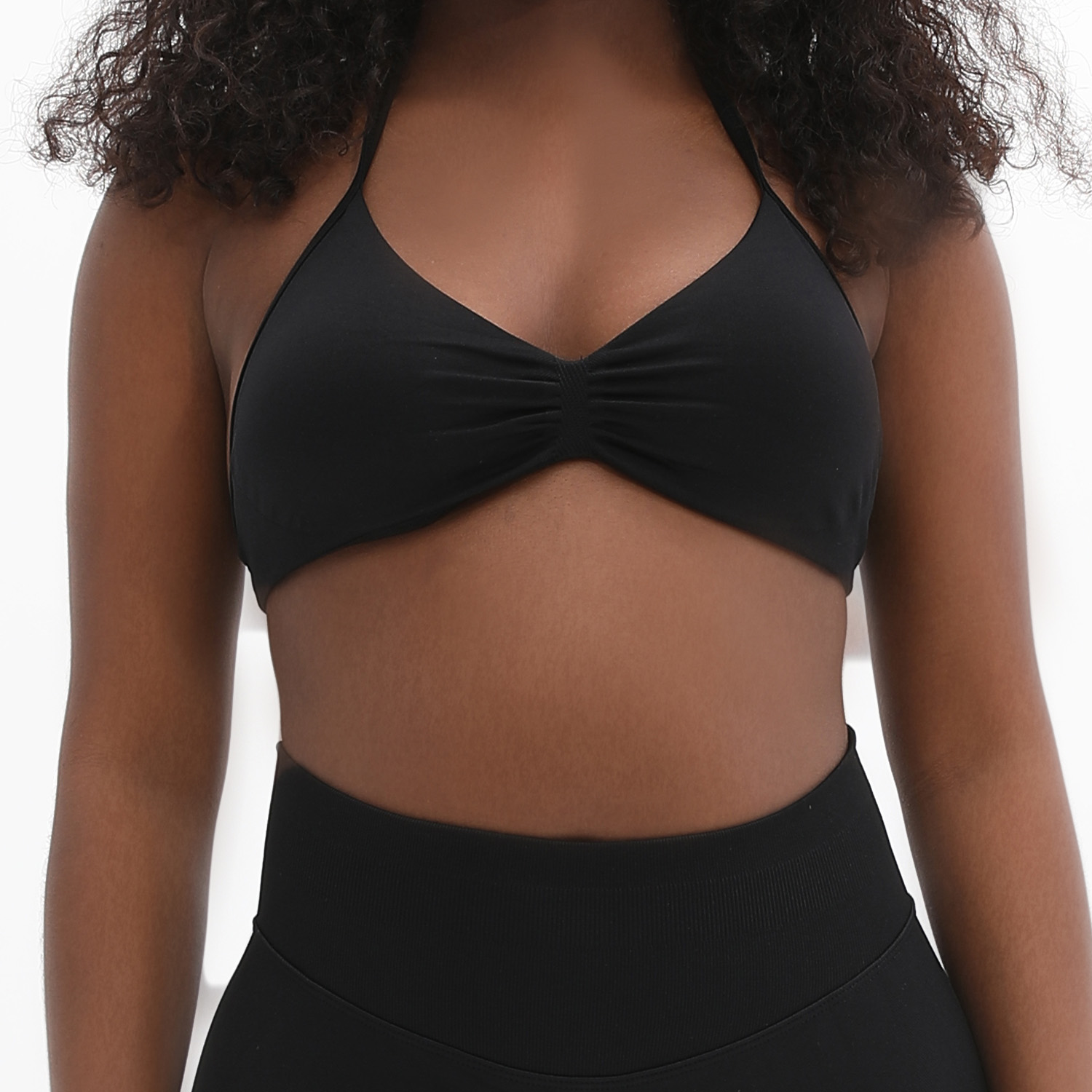
Some suppliers publish reference models that show their construction range. Jenny Knit, the trading name of Yiwu Jini Knitting Co., Ltd., lists sports bra references including the A23B022 asymmetric back-strap bra, the A23B052 flame-print scoop-neck bra, and the A23B105 fine-pattern double-strap bra. These are design references, not off-the-shelf stock: the published descriptions state that fabric, sizing, colors, and order requirements must be confirmed with the supplier before production, and that coordinating garments shown in styling photographs are separate items.
Use reference models the way you would use a portfolio. They tell you what constructions the supplier is prepared to discuss. They do not tell you the fabric you will receive, the fit you will get, or the price you will pay. Those come from your specification and the sampling process.
Warning signs in supplier evaluation
- Quotes that do not state what is included, or that change materially between conversations without a specification change.
- Reluctance to provide a sample or to identify which parts of production are subcontracted.
- Verbal assurances about testing, fiber content, or compliance without documentation.
- No clear process for approving a specification change or a failed lot.
- Photographs presented as evidence of capability with no construction detail behind them.
None of these is disqualifying on its own. A pattern of them is.
Next actions for a buyer
Narrow your shortlist to two or three suppliers that match your OEM/ODM model and category. Send the same written brief to each, request a sample against that brief, and score the samples against the same criteria. Keep the specification, the sample evaluation, and the supplier's written answers together as your decision record. That record is what protects you when bulk production begins.